Sport at any level can provide a rewarding experience, filled with joy and success. However, due to the unpredictable nature of sport along with other factors, it can also be viewed as an extremely stressful environment if the correct resources and strategies are not used. Therefore, this blog will provide an overview of the ‘stress experience’ and highlight what makes an event ‘stressful’ before giving advice and techniques which can help reinterpret this stress. Implementing these techniques should ultimately give you an edge over your competitors who may succumb to stress that you don’t even realise is there!
What is Stress?
When you ask people “what is stress?” the majority of them will say something along the lines of, stress is a negative emotion that everyone experiences in their life. I’m sure for many of you this resonates, and you would give a similar response, especially if you’ve had a stressful experience recently! Stress can be defined as “an ongoing process that involves individuals transacting with their environments, making appraisals of the situations they find themselves in, and endeavouring to cope with any issues that may arise” (1). This simply means that individuals will constantly consider the event (stressor) that has occurred, the environment they are in and their ability to cope with the event when determining whether the event is stressful to them. Therefore, stress in itself is neither positive nor negative but rather it is how we interpret the stress that determines how our bodies and mind ultimately respond. There will be more on how this occurs later.
Everyone who has played sport to any level will have experienced a stressful situation, whether it be finding yourself behind in a game, you’ve taken a fall on an apparatus, or you’ve had a disagreement with a coach. But believe it or not if responded to in the correct way, these ‘stressful’ events can result in improved performance through increased effort focus (2). Continue reading to find out how this can be achieved.

WHAT TYPE OF EVENTS INFLUENCE ME?
The stressors that may impact on an individual during sport vary in type, dimension and property. This means there are many aspects within your environment that could be percieved as stressful and lead to decreased performance. The first step to overcoming this and being able to thrive under this stress is to be aware of some of the types of stressors and where they originate from. This has been shown to be more influential than focusing on the duration of the stress (3). Furthermore, research has also discovered that both elite and non-elite athletes will experience a similar number of stressors with the demands being common across both. However as may be expected there are a few demands that are unique to each group (4). Therefore, whatever level you are competing at, increasing your knowledge of these different types of stressors will be beneficial to help tackle the stress of sport and hopefully can be used to your advantage!
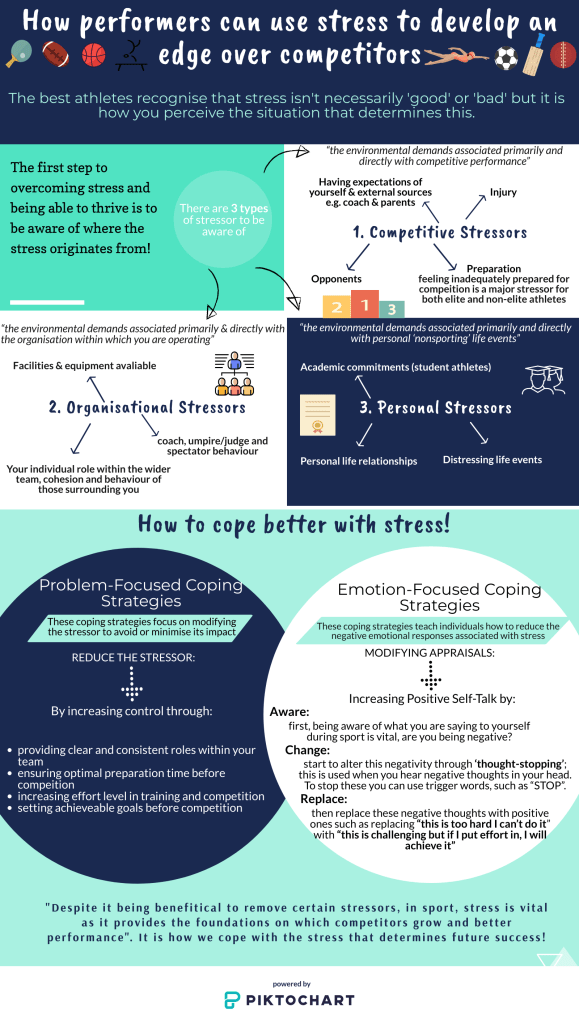
No matter how the demands of the stressor differ, they can all be categorised into one of the three types described below.
- Competitive Stressors
Definition: “the environmental demands associated primarily and directly with competitive performance” (5)
No matter what sport you partake in, such examples of these stressors include:
- your opponents
- injury
- having expectations from both yourself and external sources (e.g. coach or parent)
- preparation
- feeling inadequately prepared for compeition is a major stressor for both elite and non-elite athletes (5)
2. Organisational Stressors
Definition: “the environmental demands associated primarily and directly with the organisation within which you are operating” (6)
No matter what sport you partake in, such examples of these stressors include:
- facilities and equipment
- your individual role within the wider team
- cohesion and behaviour of those surrounding you (5)
- coach, umpire/judge and spectator behaviour
3. Personal Stressors
Definition: “the environmental demands associated primarily and directly with personal ‘nonsporting’ life events” (6)
These are slightly different stressors as all individuals are likely to experience events in their life that cause stress, examples of these include:
- academic commitments (student athletes)
- personal life relationships
- distressing life events
As you can see there are multiple stressors spreading across all domains of life that may impact on individuals’ sport performance. However, understanding where such stressors occur would enable you and your coach to work on removing stressors that can be removed, or use the stressors to elicit a positive stress response.
HAVE A GO AT IDENTIFYING WHAT ‘TYPE’ OF STRESSORS THESE ARE:
1. You turn up to training and find that all of the equipment that you need is not there ready for you.
2. You’re finding it hard to concentrate because you are worried about an argument you had with your friend.
3. It’s competition day and the girl who beat you in this competition last year is competing against you again.
Answers at the end of the blog.
HOW DOES THE STRESS AFFECT ME?
Stress is an extremely personal response to particular events, therefore a situation that you perceive to be stressful may not impact another person at all (8). This is partially due to stress being a result of an imbalance between the demands placed on an individual and their resources available to cope with these demands. The Transactional theory of stress and coping (11) identifies two processes, cognitive appraisal and coping, as critical mediators of stressful person-environment relationships and their immediate and long-term outcomes (9).This means that for an event to be classified as ‘stressful’ the individual first goes through a process of appraisal. Appraisal refers to the meaning individuals give to a particular situation and is the sense of importance ie that something is at stake (10). We will look at this process in more detail next.
WHAT DO THE EXPERTS SAY?
According to the Transactional Theory of Stress and Coping (11) it is the appraisal of a situation that determines if an individual perceives it as stressful, rather than the situation itself being stressful (8). This model proposes that appraisal occurs in two stages.
- Primary Appraisal – this occurs first and refers to the evaluation the individual makes about how significant the demand is (12)
- Secondary Appraisal – following this, individuals then evaluate what can be done to overcome the stress (9)
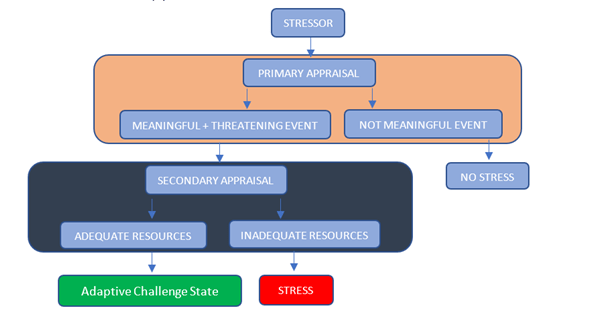
Depending on how an event is appraised you will respond in different ways – this is our response.
When appraisal results in you determining an event as stressful there are many ways you can respond, a few I’m sure you recognise:
- Psychological response, examples – doubt, worry, poor memory recall, frustration
- Physiological response, examples – muscle tensions, pounding heart
- Behavioural response, examples – fidgeting, pacing, becoming quiet, being withdrawn
However, just like our appraisal of the stress, the way we respond to stress is also highly individual with no two people responding in the same way.
HOW CAN I COPE BETTER WITH STRESS?
You are now more knowledgeable about what stress is and about the process you go through that determines whether an event is stressful. So now the blog will delve into some strategies that you can implement to help you cope better with those stressful situations that arise during sport competition or even training. Coping refers to your cognitive and behavioural efforts to manage the internal and external demands of the person-environment transaction.
According to research there are two ways we can deal with the stressor; one is focusing on the object that is causing distress (problem-focused coping) and the other is through regulating your emotion (emotion-focused coping) (9). Through investigation it appears that the environment you are in may require a different style of coping that would foster the best outcome (13).
For situations that are controllable –> problem- focused coping is ideal
For situations that are uncontrollable –> emotion-focused coping is ideal
When it comes to sport performance there is a mixture of both controllable aspects (e.g. adequate preparation) and uncontrollable aspects (e.g. opponent and umpire behaviour). Therefore, it is necessary for most sports individuals to have coping skills that cover both aspects. Furthermore, a review of stress management techniques found that 96% of stress interventions positively altered the stress experience and 77% had beneficial effect on performance across a multiple of sports (14).
Problem-Focused Coping Strategies
These coping strategies focus on modifying the stressor to avoid or minimise its impact (13).
- Reducing the stressor:
One intervention is simply to reduce the cause of the stress. This has been shown beneficial for sporting performance however can prove difficult as there will always be stress apparent that cannot be reduce without major effort.
There are multiple ways in which this can be done, these include:
- providing clear and consistent role clarity within your team
- ensuring optimal preparation time before compeition
- increasing effort level in training and competition
Emotion-Focused Coping Strategies
These coping strategies aim to teach individuals how to reduce the negative emotional responses associated with stress (15)
- Modifying appraisals:
Changing how we interpret the effects of stressors can be adaptive in order to reduce the impact they have on our performance. One such technique that has been used extensively in research is Positive Self-Talk (16).
If your self-talk is generally negative during sport, you may be perceiving events as more stressful than they need to be, creating unnecessary stress. Therefore, altering these negative thoughts and replacing them with positive and encouraging thoughts is beneficial.
To combat this these techniques can help: (17)
- Aware: first you need to be aware that this is occurring, so make yourself be more aware of what you are saying to yourself during sport.
- Change: next you need to start to alter this negativity. One way this can be achieved is through ‘thought-stopping’; this is used when you hear negative thoughts in your head, to stop this you can use trigger words, such as “STOP”.
- Replace: then you need to replace these negative statements with more positive ones such as replacing “this is too hard I can’t do it” with “this is challenging but if I put effort in, I will achieve it”
However, despite it being beneficial to remove some stressors, stress in sport is vital as it can provide the foundations on which to grow and better performance (18). It is more the way you cope with this stress that determines if you remain successful or succumb to the stress and see a decline in performance. Furthermore, being able to thrive under stress is not only important for sporting domain but all life domains as it is highly likely that stress will impact on you at some point. As a result, this blog hopes to not only give insight into how stress can impact sport but also how you can control the stress experience across your wider life as well.
Quiz Answers:
1 = Organisational Stressor
2 = Personal Stressor
3 = Competitive Stressor
References
- (1) Hanton, S., Fletcher, D., & Coughlan, G. (2005). Stress in elite sport performers: A comparative study of competitive and organizational stressors. Journal of sports sciences, 23(10), 1129-1141.
- (2) Neil, R., Hanton, S., Mellalieu, S. D., & Fletcher, D. (2011). Competition stress and emotions in sport performers: The role of further appraisals. Psychology of sport and exercise, 12(4), 460-470.
- (3) Pensgaard, A. M., & Ursin, H. (1998). Stress, control, and coping in elite athletes. Scandinavian journal of medicine & science in sports, 8(3), 183-189.
- (4) Mellalieu, S. D., Neil, R., Hanton, S., & Fletcher, D. (2009). Competition stress in sport performers: Stressors experienced in the competition environment. Journal of sports sciences, 27(7), 729-744.
- (5) Mellalieu, S. D., Hanton, S., & Fletcher, D. (2006). A competitive anxiety review: Recent directions in sport psychology research. In S. Hanton & S. D. Mellalieu (Eds.), Literature reviews in sport psychology (pp. 3). Hauppauge, NY: Nova Science.
- (6) Fletcher, D., Hanton, S., & Mellalieu, S. D. (2006). An organizational stress review: Conceptual and theoretical issues in competitive sport. In S. Hanton & S. D. Mellalieu (Eds.), Literature reviews in sport psychology (pp. 359). Hauppauge, NY: Nova Science.
- (7) Sarkar, M., & Fletcher, D. (2014). Psychological resilience in sport performers: a review of stressors and protective factors. Journal of sports sciences, 32(15), 1419-1434.
- (8) Thatcher, J., & Day, M. C. (2008). Re-appraising stress appraisals: The underlying properties of stress in sport. Psychology of sport and exercise, 9(3), 318-335.
- (9) Folkman, S., Lazarus, R. S., Gruen, R. J., & DeLongis, A. (1986). Appraisal, coping, health status, and psychological symptoms. Journal of personality and social psychology, 50(3), 571.
- (10) Dewe, P. (1991). Primary appraisal, secondary appraisal and coping: Their role in stressful work encounters. Journal of Occupational Psychology, 64(4), 331-351.
- (11) Lazarus, R. S., & Folkman, S. (1987). Transactional theory and research on emotions and coping. European Journal of personality, 1(3), 141-169.
- (12) Lazarus, R.S. (1966). Psychological stress and the coping process. New York, NY: McGraw-Hill.
- (13) Anshel, M. H., Williams, L. R. T., & Williams, S. M. (2000). Coping style following acute stress in competitive sport. The Journal of Social Psychology, 140(6), 751-773.
- (14) Rumbold, J. L., Fletcher, D., & Daniels, K. (2012). A systematic review of stress management interventions with sport performers. Sport, Exercise, and Performance Psychology, 1(3), 173.
- (15) Herman, J. L., & Tetrick, L. E. (2009). Problem‐focused versus emotion‐focused coping strategies and repatriation adjustment. Human Resource Management: Published in Cooperation with the School of Business Administration, The University of Michigan and in alliance with the Society of Human Resources Management, 48(1), 69-88.
- (16) Wallace, E. V. (2007). Managing stress: What consumers want to know from health educators. American journal of health studies, 22(1), 56.
- (17) Hanton, S., Thomas, O., & Mellalieu, S. D. (2009). Management of competitive stress in elite sport. International Olympic Committee sport psychology handbook, 30-42.
- (18) Jones, J., & Hardy, L. E. (1990). Stress and performance in sport. John Wiley & Sons.
 How performers can use stress positively to develop an edge over competitors
A well researched article which not only applies to sport but is transferable to life / work-place environment stressors. It is easy to read, factually correct with relevant glossary.
LikeLike
Such a great read! The practical applications are particularly helpful and you explain really well how easy they are to implement into performance.
LikeLike
Stress has always been a big factor in whether I do well in sport or I give up! Knowing what stress actually is and how to deal with it is so beneficial to anyone in sport. Really well presented and loved the quiz in the middle!
LikeLike
Great article! As both an athlete and a coach I definitely now feel more confident on how to act/ respond to or even avoid stressful situations within sport!
LikeLike
This is brilliant! I never would have thought to use my stress in this way but it should be so easy to do!
LikeLike
Informative and interesting article backed by academia and practical examples. Provides background and context and then solutions. Easy to follow as someone without any prior knowledge on th subject.
LikeLike
Excellent article. Some extremely useful pointers for any situation, not just sport.
LikeLike
A thought-provoking blog which encourages us to explore our understanding and increase our knowledge of stress as a factor in performance. Well researched and accessible to the non-specialist.
LikeLike
I found this very interesting. Useful for both sport and life with good practical examples. Both factual and relatable making for an easy read.
LikeLike
Hey, I enjoyed reading your blog. I look forward to testing your strategies in the field! See you in the new year.
LikeLike
Really interesting to read and see how academic research can relate to so much of our practical lives! Really useful for scenarios on and off the pitch!
LikeLike
Really interesting read, well explained and so relevant and useful to situations in and out of sporting environments!
LikeLike
Very interesting and informative piece.
LikeLike
Interesting read. I’ve always thought that stress was generally a negative response but it is interesting to learn how it can be used as a force for good.
LikeLike
Really nice read, important to let athletes, coaches, and people from all walks of life know that stress isn’t something that needs to be removed or avoided, but rather something which can be used to help individuals thrive
LikeLike
Being a student athlete, this is a great insight into how to deal with and manage stress both in sport and every day life. The clear lay out and eye catching infographic make it easy to read and process, so that I am able to implement this into my training and competitions. I look forward to your next blog post!
LikeLike
Excellent article. Some extremely useful pointers for any situation, not just sport but for all walks of life!
LikeLike
A very interesting and recommended read. Stress is such a factor in not only sport but also in everyday life. This well researched article provides some great examples in how to identify and cope with it.
LikeLike
An absolute great article! This definitely touches on some very relevant topics. I would definitely recommend
LikeLike
Fantastic overview and insight into the world of sporting pressures and coping mechanisms. The blogs structure is easy to follow. Definitely some great practical examples I can use in my own game
LikeLike
Interesting and informative, provides an insight into how stress impacts lives in general, not only in competitive sport.
LikeLike
Well researched, interesting & well-balanced blog. Easy to read & accessible to all.
LikeLike
A very insightful and helpful read. Outlining how to approach stress differently has definitely changed the way that I will view the stress that I face as a sportsperson and generally. The quiz was also super helpful in ensuring I had a working understanding of the content.
LikeLike